Is growing admin workload limiting your team's weekly job capacity?
Every job needs someone to fill out forms, check information, and chase things. In job-based industries, like automotive repair, that person's time is the limit to how much business can get done. Here's a suggestion: try sketching the process from start to finish, marking every point where someone manually moves data or has to do something repetitive. These points might be opportunities for software to do the work.
This is what gave one vehicle repair business we worked with their ops team's time back, enabling them to handle much higher workloads with the resources they already had.
Not sure where the gaps are? Novatura can audit your processes, and we'll tell you honestly whether you could benefit from a custom solution, a better off-the-shelf tool, or just a bigger spreadsheet.
Book an intro call, and we'll look under the hood
Signs your admin work needs to be handled for you:
-
One job, typed out multiple times
Into booking systems, ticketing platforms, spreadsheets, emails, and invoices.
-
Customers waiting on paperwork
Jobs are finished, but customers are waiting extra for reports, certificates or invoices.
-
Paperwork happens after hours
Your team is working long hours, potentially staying late, so Monday's jobs can start.
-
Your best technicians are at keyboards
Senior people should be doing high-value work, not fussing over admin detail.
-
The same tasks, over and over
Routine usually means rule-based, and rule-based means its automatable.
-
Workshop has capacity, the office doesn't
You could take more jobs this week, but your back office is still processing last week.
Hiring might have helped alleviate short-term pressure, but the root cause didn't go anywhere. If you tried off-the-shelf software but it didn't stick, it likely didn't integrate well with how your team is already used to working. Custom solutions can get around that problem: they should let your team work the way they're used to, while changing what's underneath.

Why it happens, and why it's actually a good sign
Too many jobs causing admin overload is better than having nothing to do - take it as a sign of growth. Back when you may have only been handling 20-30 jobs a week, a person joining up tickets, updating spreadsheets, and creating certificates of conformity by hand was a perfectly sensible system. It was flexible and the costs were barely noticeable.
Unfortunately for businesses who process orders, bookings or tickets, the admin scales just as quickly as the work volume. It starts as a few extra minutes per job and turns into hours and days lost across the business operations per week. ~10 minutes of re-keying data, across 200 jobs a week is over 33 hours. That's a nearly a full time job role's worth of time.
That's why there's pain when business is good. It's because the hidden costs are becoming hard to ignore, and your best people are feeling the squeeze.
Luckily, when the work is repetitive, rule-based, predictable, and already partly digitised - these can be the easiest kinds of bottlenecks to fix.
What you can do to help today
- 1
Draw it out
Follow a chosen workflow from start to end. Write down every time someone types, copies, checks or chases information.
- 2
Find out where the time goes
Talk to your team about your plan, and get them to verify things or contribute. Which parts would they most like to have taken off their plates? Which parts are the most time-consuming, and can you measure them? Against your diagram, multiply the manual time by your weekly job volume. That's where the return on investment potential lives.
- 3
Check: is the solution already there?
Your existing tools may already be up to the task. Most of the time, we don't get the full value from the tools we already use every day. There might be a feature that's a single click away, so it's worth checking.
- 4
Build a proof of concept
Experiment with no-code tools, like Zapier. These connect systems together with simple rules, from which you can try creating a prototype automation yourself. If you're up to the challenge, you could even try this with an AI app-builder like Lovable, or a coding agent like Claude Code. Beware, though, prototypes are meant to be outgrown. While these approaches can be good for low-risk workflows and automating simple tasks, for many business systems, they're not the right answer. More on that below.
- 5
Cut out the busy work
Ask why. Sometimes, we perform tasks because "it's the way we've always done it". Always ask why, and then keep asking why. If you can't find a good answer, it might not need to exist.
A piece of advice: one of the biggest barriers to adopting changes in processes is ultimately the people behind the systems. Before you commit to something, ask yourself: how will your team receive this, and how can you make it easy to use?

Outgrown DIY? When to go bespoke
Building your own prototypes is a fantastic way to experiment and figure out how things could work. The reality is that most people are too busy to invest the time in doing it themselves. However, there are quiet costs and limitations to managing your own systems:
- You are responsible. When things break, do you have the time to be your own developer and support team?
- Software needs regular maintenance and security patches. If you don't stay on top of it, your systems quietly accumulate cyber risk.
- No-code solutions are good for simple workflow automation, but past that, they quickly become too complex to maintain and edit. For business-critical systems, you should consider something more reliable.
The challenge is finding a solution that maximises the benefits of a tailor-made solutions and minimises the risks of embedding them within your operations.
Here's why businesses choose Novatura
We're more than just an agency, we specialise in building bespoke systems. We've built solutions for numerous companies, mainly in the UK motor industry, with a successful track record. Our work doesn't end with the project, we're a long term partner who supports the systems that growing businesses run on. We work in the background so you can get on with what matters to you.
Here's how we'll start, and what you'll receive at each step:
-
Free Discovery Call
Some friendly advice and a roadmap, based on what matters most to you.
-
Systems Audit
In-depth report of what you've got, and what we would suggest to improve it.
-
Build & Look After
A solution that's easy to use, then look after it to ensure ongoing success.
Here's the proof; we've helped with this before
Read about the journeys our partners have been on — or take a look at our other case studies
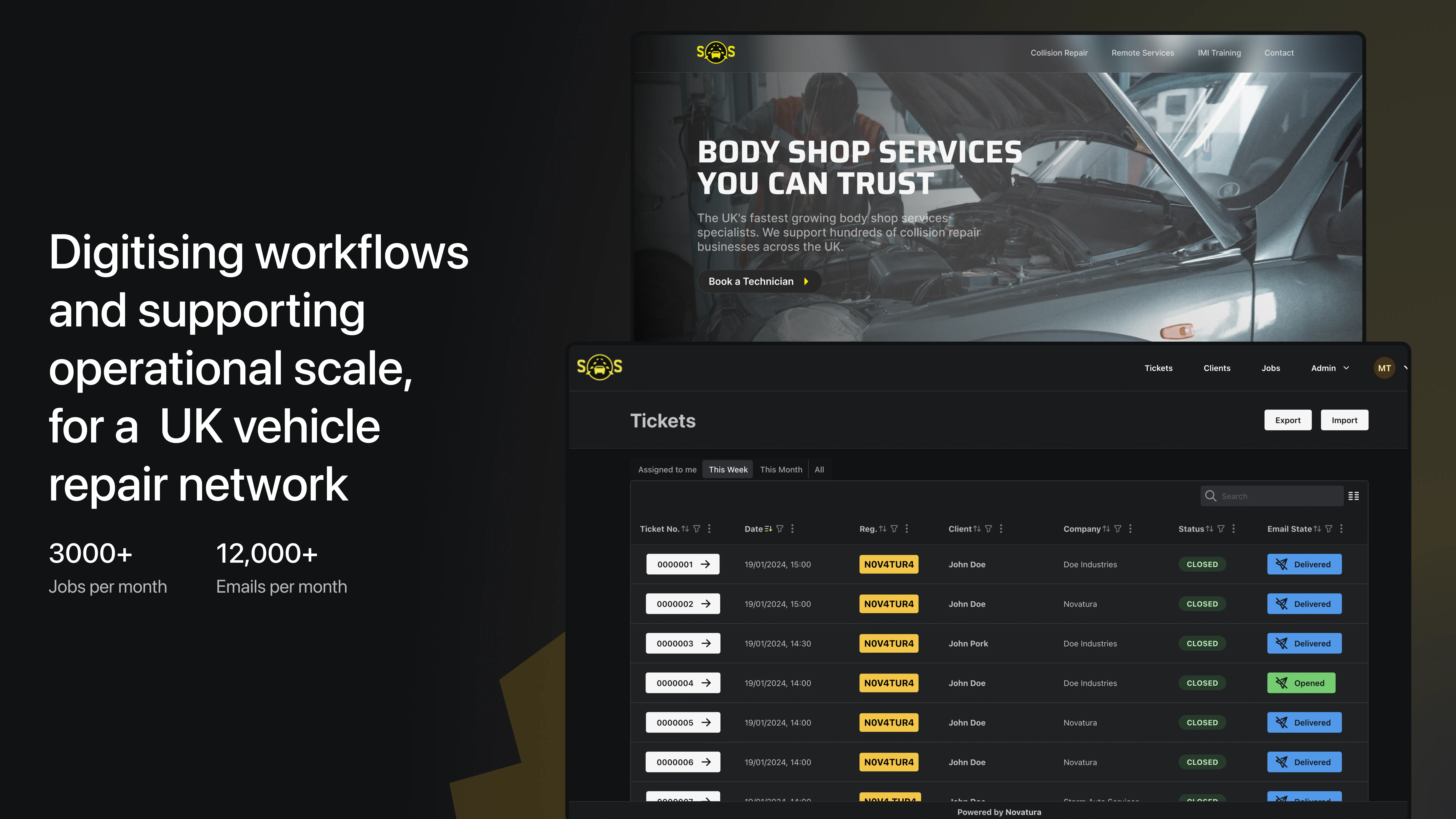
Vehicle Repair Ticketing Dashboard
The bespoke operations portal that turned into a 3 year partnership.
Read the case study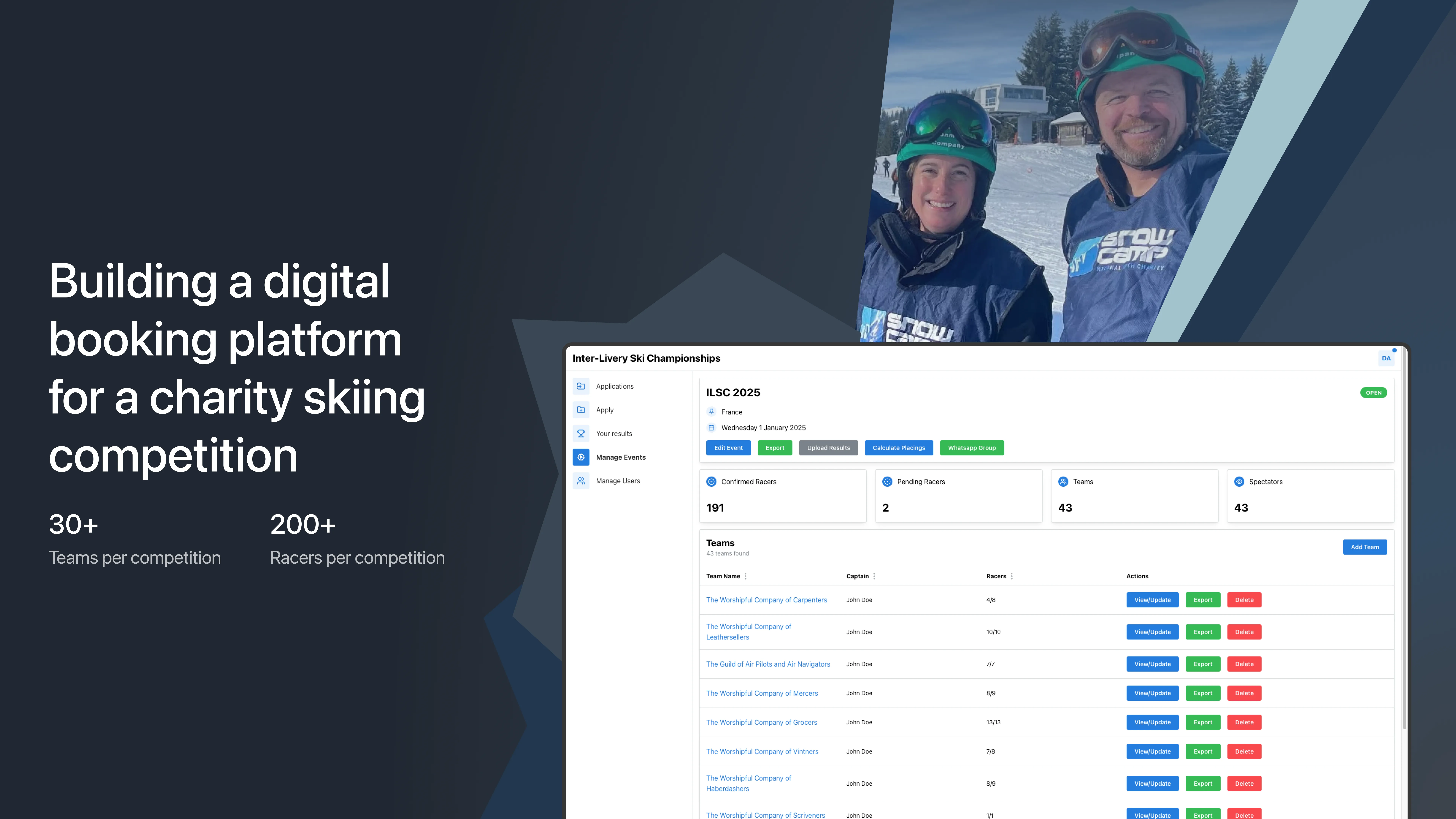
Ski Competition Booking Platform
Giving organisers their evenings back by removing recurring admin workload.
Read the case studyBook your free discovery call
Reach out and we'll get the ball rolling. You'll hear back from James (our Business Development Director) personally, usually within a few hours.
Frequently asked questions
Here are some of the most common questions we get asked by prospective partners looking to work with us.
Ask us a questionThe systems we build at Novatura are typically unique and bespoke to your business. Ownership and intellectual property rights go to the client in these cases. If there's a real commercial opportunity to productise, that you weren't already considering, we might discuss it with you up front. It's completely against our morals to trick you into paying for a licence to use software that you paid us to build.
Don't just take our word for it, hear from our clients.
See our latest projectsProjects completed
Repeat clients

Dr Nick Broughton
Ethos Pharmaceutical Ltd.The team at Novatura designed and built our new WordPress site, including a members-only area and events booking system - they provided a great service, working with us to define requirements, iterate on design and deliver the final product. We're thrilled with the results and would highly recommend them to other small businesses looking to launch a new online presence!

Kevin & Dora
Global Security Group LtdNovatura digitised our database, making it more accessible and secure. They also updated our website, making it more appealing and informative for our customers. The team were professional, with a young, innovative approach and individual touch.

Emma Halford-MacLeod
Worshipful Company of IronmongersThe team at Novatura have been absolutely brilliant throughout building our new web platform. We are very pleased and would highly recommend their services.

Ben Peters
Hummingbird Insurance Services LtdWe knew the problem we wanted to solve because we’d lived it ourselves. What we needed was the technical capability to turn that industry knowledge into a platform that could scale with our customers. Novatura challenged our thinking, helped us turn a very broad product vision into something deliverable, and gave us the flexibility to keep developing as customer feedback came in. The relationship has allowed us to stay focused on the commercial and industry side of SHIELD while having a technical team we trust behind the product.

Richard Yorston
Storm Auto ServicesNovatura has done plenty of work for us and consistently provide high-quality solutions to our problems. Their continued support has been fantastic as they resolve any issues quickly and effectively, giving me peace of mind while I manage the rest of my business.